
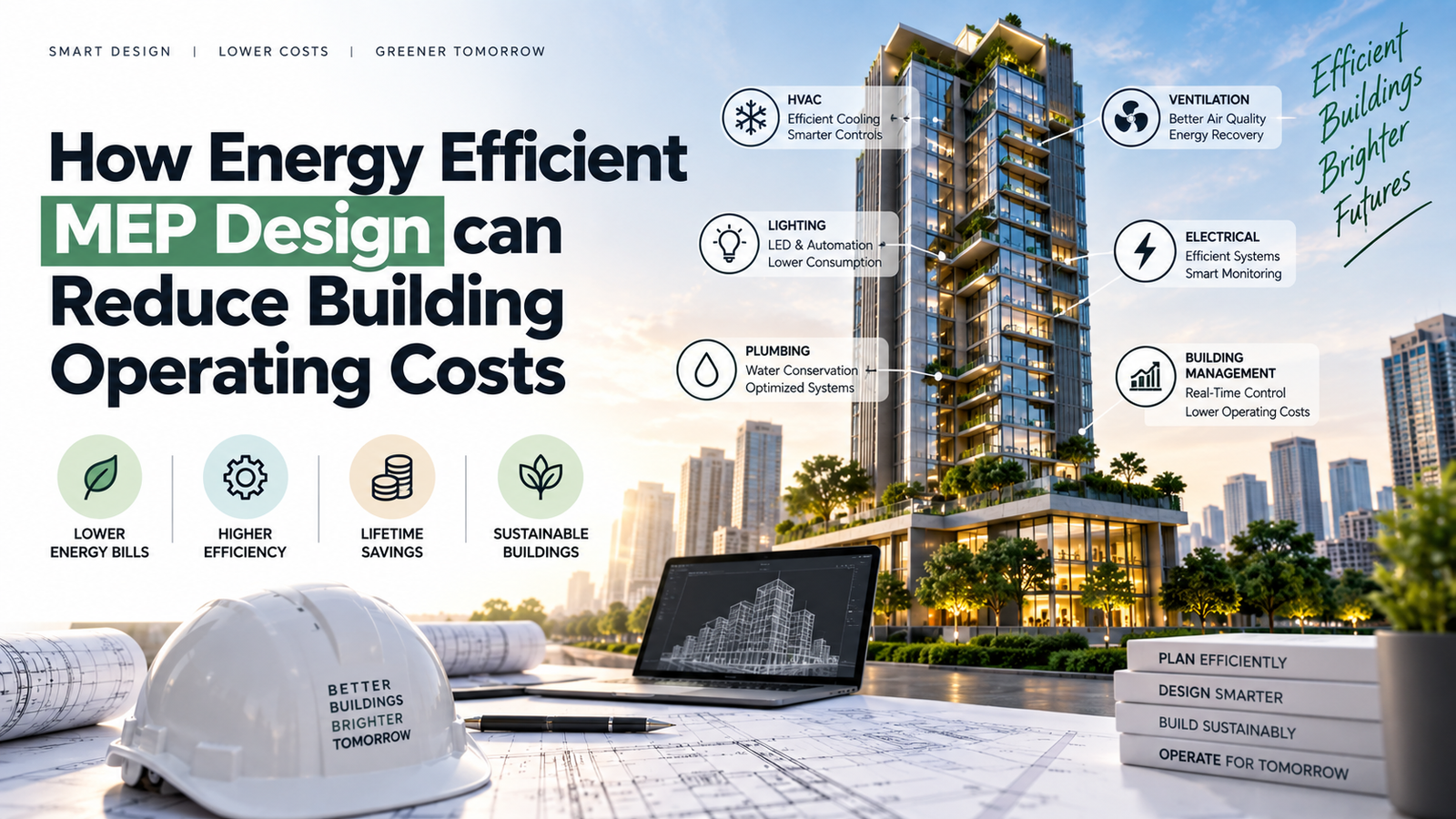
How Energy-Efficient MEP Design Can Reduce Building Operating Costs
A building’s construction cost is easy to see. Its operating cost is not. Yet for most commercial, residential, hospitality and institutional buildings, energy and utility expenses continue long after construction is complete. This is why energy-efficient MEP design should be considered during the design stage rather than treated as an upgrade after the building is finished.
Mechanical, electrical and plumbing systems account for a significant portion of a building’s energy and water consumption. HVAC equipment, pumps, fans, lighting, hot-water systems, ventilation, elevators and other services all contribute to the building’s operating profile.
A well-designed MEP system can reduce unnecessary energy consumption while maintaining occupant comfort, indoor air quality, water availability, safety and system reliability. More importantly, efficient design can reduce recurring operating expenses over the entire life of the building.
This guide explains how energy-efficient MEP design can reduce building operating costs, which systems have the greatest impact, and what developers, architects, contractors and MEP engineers should consider when planning an efficient building.
What Is Energy-Efficient MEP Design?
Energy-efficient MEP design is the process of designing mechanical, electrical and plumbing systems to deliver the required performance while using as little energy and water as reasonably practical.
It is not simply about installing high-efficiency equipment. A building can have highly efficient chillers, pumps and lighting fixtures and still consume excessive energy if the systems are poorly sized, badly controlled or operated outside their intended conditions.
Efficient MEP design therefore considers the complete system rather than individual equipment.
An energy-efficient MEP strategy may include:
- Efficient HVAC equipment and system selection.
- Accurate cooling and heating load calculations.
- Variable-speed pumps and fans.
- High-efficiency lighting.
- Occupancy-based controls.
- Building management systems.
- Efficient domestic water systems.
- Hot-water energy optimization.
- Power factor and electrical system optimization.
- Renewable energy integration.
- Energy monitoring and submetering.
- Efficient operation and maintenance strategies.
Why MEP Design Has a Major Impact on Operating Costs
A building’s MEP systems operate for years, often continuously. A small inefficiency in equipment selection or system design can therefore become a significant expense when multiplied by thousands of operating hours.
Consider a pump that consumes slightly more electricity than necessary. The additional consumption may seem insignificant on a single day. Over a year, however, the extra energy can become substantial. Multiply that by dozens of pumps, fans and air-conditioning systems and the impact on operating costs becomes much more noticeable.
This is why MEP engineers need to consider both capital cost and lifecycle cost.
Efficient MEP design can influence:
- Electricity consumption.
- Water consumption.
- Peak electrical demand.
- Equipment maintenance costs.
- Replacement frequency.
- Occupant comfort.
- Equipment operating life.
- Carbon emissions.
- Overall building operating expenses.
Understanding Building Energy Consumption
Before reducing energy consumption, engineers need to understand where energy is being used.
The exact energy profile varies according to building type, climate, occupancy and operating schedule. An office building may have a different consumption pattern from a hotel, hospital, shopping centre or residential tower.
Major building energy consumers can include:
- Heating, ventilation and air-conditioning.
- Lighting.
- Water pumping.
- Domestic hot-water systems.
- Fans and ventilation equipment.
- Lifts and escalators.
- Kitchen equipment.
- IT and server systems.
- Building automation systems.
- External and landscape systems.
In many buildings, HVAC represents one of the largest energy-consuming systems, making mechanical design one of the most important areas for energy optimization.
Start With Accurate Load Calculations
One of the simplest ways to improve MEP efficiency is to avoid designing systems around inaccurate loads.
Oversized equipment can operate inefficiently, cycle unnecessarily or operate away from its optimal efficiency range. Undersized systems can struggle to maintain required conditions and may operate continuously at high load.
Accurate MEP load calculations should therefore be completed before major equipment is selected.
Load calculations may include:
- Building cooling load.
- Heating load where applicable.
- Electrical connected load.
- Maximum electrical demand.
- Domestic water demand.
- Hot-water demand.
- Ventilation requirements.
- Pump and fan requirements.
The objective is to select equipment based on realistic design conditions rather than simply adding large safety margins to every calculation.
HVAC: One of the Biggest Opportunities for Energy Savings
HVAC systems can have a major influence on building energy consumption. Cooling loads are affected by climate, building orientation, glazing, occupancy, lighting, equipment, ventilation and building envelope performance.
Energy-efficient HVAC design therefore begins before the chiller or air-conditioning unit is selected.
HVAC efficiency can be improved through:
- Accurate cooling-load calculations.
- High-efficiency chillers or air-conditioning equipment.
- Variable-speed compressors where appropriate.
- Variable-speed pumps.
- Variable-air-volume systems where suitable.
- Efficient air-handling units.
- Demand-controlled ventilation.
- Heat recovery systems where appropriate.
- Optimized chilled-water temperatures.
- Effective HVAC controls.
Avoiding HVAC Oversizing
Oversizing HVAC equipment is a common design issue. It may appear safer to install a larger system, but larger does not automatically mean better.
An oversized cooling system may satisfy the thermostat quickly and cycle on and off more frequently. Depending on the equipment and operating conditions, this can reduce efficiency and affect humidity control and occupant comfort.
Proper load calculations help engineers select equipment that matches the actual building requirements more closely.
Variable Speed Drives and Energy Savings
Variable-frequency drives, commonly known as VFDs, allow motors to operate at different speeds according to actual system demand.
This is particularly useful for pumps and fans because these systems frequently operate at less than their maximum design capacity.
VFDs can be applied to:
- Chilled-water pumps.
- Condenser-water pumps.
- AHU fans.
- Fresh-air fans.
- Exhaust fans.
- Booster pumps.
- Cooling-tower fans.
Instead of running a motor continuously at full speed and controlling the process through throttling or other inefficient methods, a variable-speed system can adjust output according to demand.
Efficient Pump Design
Pumps are often overlooked when energy efficiency is discussed, but large buildings can have numerous pumps operating for long periods.
Domestic water pumps, chilled-water pumps, condenser-water pumps, sewage pumps and other systems all contribute to electrical consumption.
Efficient pump design should consider:
- Accurate flow requirements.
- Total dynamic head.
- Pipe friction losses.
- Equipment pressure losses.
- Pump efficiency.
- Operating point.
- Variable-speed operation.
- Duty and standby requirements.
- Control strategy.
Selecting a pump that operates close to its intended efficiency range can reduce unnecessary energy consumption throughout its operating life.
Reducing Pressure Losses in Plumbing Systems
Plumbing design can also influence energy consumption. Excessive pressure losses force pumps to operate at higher heads than necessary.
Pipe diameter, fittings, valves, water velocity and system layout all contribute to pressure loss.
The objective is not to oversize every pipe. Instead, the system should be hydraulically optimized to achieve an appropriate balance between pipe cost and pumping energy.
Energy-efficient plumbing design can include:
- Hydraulically optimized pipe sizing.
- Efficient pressure zoning.
- Variable-speed booster pumps.
- Pressure-reducing valves where appropriate.
- Low-flow fixtures.
- Leak detection.
- Water metering.
Lighting Design and Energy Efficiency
Lighting is another major area where MEP design can reduce energy consumption.
Modern LED lighting can provide high efficiency, long service life and good controllability. But simply replacing traditional fixtures with LEDs is only one part of an efficient lighting strategy.
Efficient lighting design should consider:
- Actual illumination requirements.
- Efficient LED fixtures.
- Daylight availability.
- Occupancy sensors.
- Daylight sensors.
- Time scheduling.
- Dimming controls.
- Automatic switching.
- Common-area lighting controls.
A lighting system that is switched on at full output throughout the day is unlikely to be as efficient as one that responds to occupancy and available daylight.
Daylight Integration
Architectural design and MEP design should work together to make better use of natural daylight.
Where daylight provides sufficient illumination, lighting controls can reduce artificial lighting output. This can lower electricity consumption without compromising the required visual environment.
Daylight strategies should be coordinated with glare control, solar heat gain and occupant comfort rather than treating daylight as a standalone energy-saving measure.
Building Management Systems and Smart Controls
Efficient equipment can still waste energy if it operates at the wrong time or under the wrong conditions. Building management systems, or BMS, help address this issue by monitoring and controlling building services.
A BMS can monitor and control:
- HVAC operating schedules.
- Room temperatures.
- Chiller operation.
- Pump operation.
- Fan speeds.
- Lighting schedules.
- Energy meters.
- Equipment alarms.
- Indoor environmental conditions.
The real benefit comes from using the collected data to make better operating decisions.
Occupancy-Based Energy Management
Buildings are rarely occupied at full capacity all the time. An office may be nearly empty during weekends, meeting rooms may remain unused for hours and common areas may experience significant variations in occupancy.
MEP systems can be designed to respond to these changes.
Occupancy-based controls can be used for:
- Lighting.
- Air-conditioning.
- Ventilation.
- Meeting rooms.
- Toilet exhaust systems.
- Parking ventilation.
- Common areas.
Instead of conditioning and illuminating an empty space at full capacity, the system can reduce operation when demand falls.
Ventilation and Energy Efficiency
Ventilation is necessary for indoor air quality, but bringing outdoor air into a building can increase heating or cooling loads.
The solution is not to reduce ventilation below required levels. Instead, ventilation should be controlled intelligently according to occupancy and applicable indoor-air-quality requirements.
Demand-controlled ventilation can adjust outdoor-air quantities based on occupancy indicators such as carbon-dioxide concentration where appropriate.
Heat Recovery Systems
In buildings with substantial ventilation requirements, energy recovery can reduce the energy penalty associated with conditioning outdoor air.
Depending on the system and climate, heat or energy recovery devices can transfer energy between outgoing and incoming air streams.
Potential benefits include:
- Reduced cooling energy.
- Reduced heating energy where applicable.
- Improved ventilation efficiency.
- Reduced load on HVAC equipment.
The suitability of heat recovery depends on building use, air quality requirements, climate and system configuration.
Efficient Hot-Water Design
Hot-water systems can consume significant energy, particularly in hotels, hospitals, residential developments and facilities with high domestic hot-water demand.
Energy-efficient hot-water design should consider both the generation system and the distribution network.
Potential efficiency measures include:
- High-efficiency water heaters.
- Heat-pump water heating where suitable.
- Proper pipe insulation.
- Efficient hot-water circulation.
- Temperature control.
- Solar hot-water systems where appropriate.
- Efficient fixtures.
- Heat recovery opportunities.
Reducing heat loss from distribution pipes can be particularly useful in buildings with long hot-water circulation networks.
Water Efficiency Also Reduces Energy Costs
Water and energy are closely connected. Every litre of water that is pumped, treated, heated or transported requires resources and, in many cases, energy.
Reducing unnecessary water consumption can therefore reduce both water and energy-related operating costs.
Water-efficient strategies include:
- Low-flow fixtures.
- Efficient flush systems.
- Leak detection.
- Water submeters.
- Efficient irrigation.
- Rainwater harvesting where appropriate.
- Greywater reuse where permitted.
- Efficient pump control.
Electrical Distribution Efficiency
Electrical system design also affects energy losses within a building.
Transformers, cables, busbars, switchgear and other distribution equipment experience losses during operation. These losses may appear small individually but can become significant over long operating periods.
Electrical efficiency can be improved through:
- Appropriate transformer selection.
- Efficient distribution architecture.
- Correct cable sizing.
- Reduced unnecessary voltage drop.
- Power factor management.
- Efficient motors.
- Harmonic assessment where required.
- Energy monitoring.
Cable sizing should not be based solely on minimum permissible ampacity. For certain applications, lifecycle energy losses can also be considered when evaluating conductor sizes.
Power Factor and Operating Costs
Power factor affects current and apparent power in AC electrical systems. Poor power factor can increase current for a given real power requirement and may affect electrical infrastructure and utility-related costs depending on the supply arrangement.
Appropriate power factor correction may therefore form part of an energy-management strategy where justified by the building’s load profile and utility requirements.
Engineers should also distinguish between displacement power factor and broader power-quality issues associated with nonlinear loads.
Efficient Motor Selection
Motors are found throughout MEP systems. Pumps, fans, cooling towers, compressors and other equipment rely on electric motors.
Selecting efficient motors can reduce electricity consumption over their operating life.
Motor selection should consider:
- Motor efficiency.
- Expected operating hours.
- Load profile.
- Starting requirements.
- Variable-speed operation.
- Maintenance requirements.
- Actual duty point.
A highly efficient motor operating at an inappropriate load point may still be less effective than a correctly sized motor selected for the actual system requirements.
Elevators and Vertical Transportation
Elevators and escalators are another area where energy efficiency can be considered during MEP planning.
Efficient elevator systems can include regenerative drives, efficient motors, standby modes and intelligent control strategies.
Energy considerations may include:
- Motor efficiency.
- Drive efficiency.
- Regenerative braking.
- Lighting and ventilation in lift cars.
- Standby modes.
- Traffic management.
Vertical transportation should be coordinated with the building’s electrical load calculation because lift demand can contribute significantly to the overall electrical infrastructure.
Renewable Energy Integration
Energy efficiency should generally be addressed before adding renewable generation. Reducing the building’s demand first can make renewable systems more effective.
Solar photovoltaic systems are particularly relevant to commercial and residential buildings with suitable roof or façade areas.
Solar PV planning should consider:
- Available roof area.
- Solar exposure.
- Building load profile.
- Inverter capacity.
- Grid connection requirements.
- Electrical protection.
- Maintenance access.
- Future expansion.
The MEP team should coordinate the solar system with the building’s electrical distribution and energy-management strategy.
Battery Energy Storage and MEP Design
Battery energy storage systems can provide additional flexibility in buildings with suitable applications. Depending on the project, batteries can support peak-demand management, backup power strategies or better integration of renewable energy.
Their use requires careful consideration of electrical capacity, protection, thermal management, fire safety, ventilation, space and applicable regulations.
Energy Metering and Submetering
You cannot effectively manage what you cannot measure.
Energy metering allows building operators to understand where electricity is being consumed and identify unusual patterns.
Submetering may be provided for:
- Major HVAC systems.
- Individual tenants.
- Common areas.
- Lighting systems.
- Large mechanical equipment.
- Data centres.
- Kitchen facilities.
- EV charging systems.
Detailed metering can help identify systems that consume more energy than expected and provide data for future optimization.
Building Automation and Continuous Optimization
Energy efficiency does not end when construction is complete. A building’s actual operation may differ significantly from the assumptions made during design.
Monitoring systems can help operators compare actual performance against expected performance and identify opportunities for improvement.
Continuous optimization can involve:
- Reviewing energy consumption trends.
- Checking HVAC operating schedules.
- Monitoring equipment efficiency.
- Identifying abnormal energy use.
- Optimizing setpoints.
- Maintaining filters and coils.
- Checking pumps and fans.
- Reviewing tenant consumption.
Why Preventive Maintenance Matters
Even the most efficient MEP system can become inefficient when it is poorly maintained.
Dirty filters increase fan resistance. Fouled heat exchangers reduce heat-transfer performance. Poorly maintained pumps may operate away from their intended performance. Leaking valves and pipes waste water and energy.
Preventive maintenance can include:
- HVAC filter replacement.
- Coil cleaning.
- Chiller performance checks.
- Pump inspection.
- Fan and belt maintenance.
- Valve inspection.
- Leak detection.
- Sensor calibration.
- Energy-meter verification.
Maintenance should therefore be considered part of the building’s energy strategy rather than a separate facility-management activity.
Lifecycle Cost vs Initial Cost
One of the biggest challenges in energy-efficient design is balancing upfront investment with long-term savings.
Some efficient systems cost more initially but consume less energy over their operating life. Others may have similar capital costs but provide savings through better controls or system optimization.
Developers should therefore evaluate significant MEP decisions using lifecycle cost rather than purchase price alone.
Lifecycle evaluation can consider:
- Initial equipment cost.
- Installation cost.
- Energy consumption.
- Water consumption.
- Maintenance costs.
- Replacement costs.
- Expected operating hours.
- Equipment life.
- Financing and project-specific economic assumptions.
Simple Example of Lifecycle Thinking
Consider two HVAC equipment options. One has a lower purchase price but consumes more electricity, while the other costs more initially but has better operating efficiency.
If the building operates for many hours each year, the difference in electricity consumption can eventually exceed the initial price difference.
The better option is therefore not necessarily the equipment with the lowest purchase price. It may be the option that provides the most appropriate balance between capital cost, energy consumption, maintenance and expected service life.
Energy-Efficient MEP Design for Different Building Types
Commercial Buildings
Offices and commercial developments can benefit significantly from HVAC optimization, lighting controls, occupancy sensors, efficient ventilation and tenant-level energy monitoring.
Residential Buildings
Residential projects can focus on efficient lighting, pumps, domestic hot water, elevators, common-area HVAC, water conservation and smart metering.
Hotels
Hotels operate around the clock and often have significant HVAC, hot-water, kitchen and laundry loads. Occupancy-based room controls and efficient central systems can provide meaningful savings.
Hospitals
Healthcare facilities have complex ventilation, cooling, medical equipment and reliability requirements. Energy efficiency must be achieved without compromising infection control, patient safety or critical environmental conditions.
Industrial Buildings
Industrial facilities may have large process loads, motors, compressed-air systems, ventilation systems and specialized equipment. Process optimization can therefore be as important as conventional building-services efficiency.
Energy-Efficient MEP Design and BIM
BIM can support energy-efficient MEP design by improving coordination and allowing engineers to understand how systems occupy and interact within the building.
A coordinated BIM model can help reduce unnecessary pipe and duct lengths, identify equipment access issues, coordinate plant rooms and improve service routing.
BIM can support:
- MEP coordination.
- Plant-room optimization.
- Equipment space planning.
- Service routing.
- Quantity extraction.
- Energy modelling workflows.
- Construction coordination.
- Facility-management information.
BIM does not automatically make a building energy efficient, but it provides a stronger platform for coordinated design and performance analysis.
Energy Modelling During Design
Energy modelling can help project teams estimate how design decisions may influence building energy consumption before construction.
Depending on the project’s scope, models can evaluate the influence of factors such as building envelope, HVAC systems, lighting, occupancy and operating schedules.
This gives the design team an opportunity to compare alternatives before equipment and systems are finalized.
Common Mistakes That Increase Building Operating Costs
Many inefficient buildings do not suffer from a lack of expensive technology. They suffer from basic design and coordination decisions that were not optimized.
1. Oversized Equipment
Oversized chillers, pumps, fans and air-conditioning units can increase capital cost and may operate inefficiently at actual building loads.
2. Poor Controls
Efficient equipment can waste energy if it runs continuously when there is little or no demand.
3. Incorrect Pump Selection
Pumps selected without accurate hydraulic calculations can consume unnecessary energy throughout their operating life.
4. Excessive Pressure
Excessive water pressure can increase pumping energy and may contribute to higher flow and leakage.
5. Poor Insulation
Inadequate insulation on chilled-water, hot-water and HVAC systems can increase thermal losses and reduce system efficiency.
6. No Energy Monitoring
Without appropriate metering, building operators may have difficulty identifying abnormal consumption or underperforming systems.
7. Designing for Peak Conditions Only
Buildings operate across a range of loads. Designing systems only around peak conditions without considering part-load performance can result in poor efficiency during most operating hours.
Designing for Part-Load Efficiency
A building may reach its peak design load only for a limited number of hours each year. For the rest of the time, systems operate at partial load.
This makes part-load efficiency extremely important when selecting HVAC equipment, pumps, fans and other systems.
Engineers should evaluate:
- Expected annual operating profile.
- Minimum operating load.
- Typical operating load.
- Peak load.
- Equipment efficiency across load ranges.
- Control strategy.
- Equipment staging.
Equipment that performs well only at full load may not necessarily be the most efficient choice for a building that spends most of its operating time at partial load.
How Developers Can Reduce Long-Term MEP Costs
Developers have the greatest opportunity to influence lifecycle operating costs during the early design stage.
Key decisions include:
- Setting energy-performance objectives early.
- Allocating adequate space for efficient equipment.
- Evaluating lifecycle cost instead of first cost alone.
- Requesting realistic energy calculations.
- Reviewing HVAC efficiency and part-load performance.
- Providing appropriate energy metering.
- Considering renewable energy integration.
- Planning for efficient building controls.
- Allowing space for maintenance and future upgrades.
A slightly higher design investment can be justified when it produces reliable long-term savings and improved building performance.
Energy-Efficient MEP Design Checklist
The following checklist can be used during design reviews to identify major opportunities for improving building energy performance.
- Building energy-performance objectives established.
- Cooling and heating loads accurately calculated.
- HVAC equipment appropriately sized.
- Part-load performance reviewed.
- Variable-speed operation considered.
- Pumps selected using accurate hydraulic calculations.
- Fan systems optimized.
- Lighting power minimized without compromising required illumination.
- Occupancy and daylight controls considered.
- Hot-water systems optimized.
- Pipe and duct insulation reviewed.
- Electrical distribution losses considered.
- Power factor reviewed.
- Major equipment individually metered where appropriate.
- BMS strategy established.
- Energy monitoring provided.
- Water-saving fixtures considered.
- Leak detection considered.
- Solar PV feasibility reviewed.
- Energy storage evaluated where appropriate.
- BIM coordination completed.
- Lifecycle cost considered for major MEP equipment.
- Maintenance strategy incorporated into design.
- Applicable energy codes and project requirements verified.
Frequently Asked Questions About Energy-Efficient MEP Design
What is energy-efficient MEP design?
Energy-efficient MEP design involves designing mechanical, electrical and plumbing systems to achieve the required building performance with optimized energy and water consumption. It includes efficient equipment, accurate sizing, effective controls, proper coordination and lifecycle considerations.
Which MEP system consumes the most energy in a building?
The answer depends on the building type, climate and operating profile. HVAC is often one of the largest energy consumers in commercial buildings, while lighting, hot water, pumps, ventilation and specialized equipment can also represent significant loads.
How does HVAC design affect building operating costs?
HVAC design affects electricity consumption through equipment efficiency, system sizing, controls, operating schedules, ventilation requirements and part-load performance. Accurate cooling-load calculations and appropriate equipment selection can help reduce unnecessary energy consumption.
Can energy-efficient MEP design reduce construction costs?
Not necessarily in every case. Some energy-efficient solutions require additional upfront investment. However, optimized system sizing can sometimes reduce capital costs, while efficient equipment and controls can reduce operating expenses over the building’s lifecycle.
Why is equipment sizing important for energy efficiency?
Equipment that is significantly oversized may operate inefficiently during typical part-load conditions, while undersized equipment may struggle to maintain required conditions. Accurate load calculations help engineers select equipment that better matches the actual design requirements.
How do VFDs save energy?
VFDs allow motors to operate at variable speeds rather than continuously operating at full speed. For applications such as pumps and fans, reducing speed according to demand can significantly reduce energy consumption under suitable operating conditions.
Does BIM help improve energy efficiency?
BIM can support energy-efficient MEP design by improving coordination, equipment planning, service routing and information management. When combined with energy analysis tools and proper engineering calculations, BIM can become part of a broader building-performance workflow.
Why is energy monitoring important?
Energy monitoring allows building operators to understand actual consumption and identify abnormal or inefficient operation. Without reliable data, it is difficult to verify whether the building is performing as expected.
How can plumbing design reduce energy consumption?
Plumbing systems can reduce energy use through efficient pump selection, optimized pressure zones, variable-speed pumping, reduced pressure losses, efficient hot-water systems, proper insulation and water-conservation measures.
What is lifecycle cost in MEP design?
Lifecycle cost considers the total financial impact of an MEP system over its useful life, including initial purchase and installation costs, energy consumption, maintenance, repairs and replacement. It provides a broader basis for comparing design options than initial cost alone.
Final Thoughts
Energy efficiency in buildings does not come from one piece of equipment or one technology. It comes from hundreds of design decisions working together.
A correctly sized chiller, an efficient pump, a well-designed duct system, properly controlled lighting, optimized water pressure, effective insulation and a reliable building management system may each contribute a relatively small improvement on their own. Together, however, they can have a substantial impact on the building’s long-term energy performance.
For developers, this means looking beyond the initial construction budget and considering what the building will cost to operate for the next 10, 20 or 30 years. For MEP engineers, it means designing systems around actual loads, realistic operating conditions and lifecycle performance rather than simply selecting equipment based on maximum capacity.
The most effective energy-efficient MEP strategy is one that begins early. Architecture, structure, MEP systems, controls and building operations should be considered as parts of the same performance strategy.
Ultimately, an efficient building is not simply a building that consumes less energy. It is a building that delivers the required comfort, safety, reliability and functionality while using resources intelligently and keeping operating costs under control.